Switzerland has four national languages: German, French, Italian and Romansh. Which one you hear depends on the region you’re in, and German is the most widely spoken.
The catch is that the language flips as you cross a border, and your translation app goes quiet the moment your signal does.
Switzerland has four national languages, and German is the most spoken
Four languages hold national status in Switzerland: German, French, Italian and Romansh. German comes first, as the main language of 61% of the population, ahead of every other tongue (Federal Statistical Office, 2023).
French follows at 23%. Italian sits at 8%, and Romansh at 0.5%. Other languages make up the remaining 24%, so a share of the people you meet speak something that isn’t on the national list.
For your trip, that means one language will cover most of the country, and three others will show up the moment you head west or south. Learn which is which before you land.
Which language will you hear in Zurich, Geneva, Lugano and Graubünden?
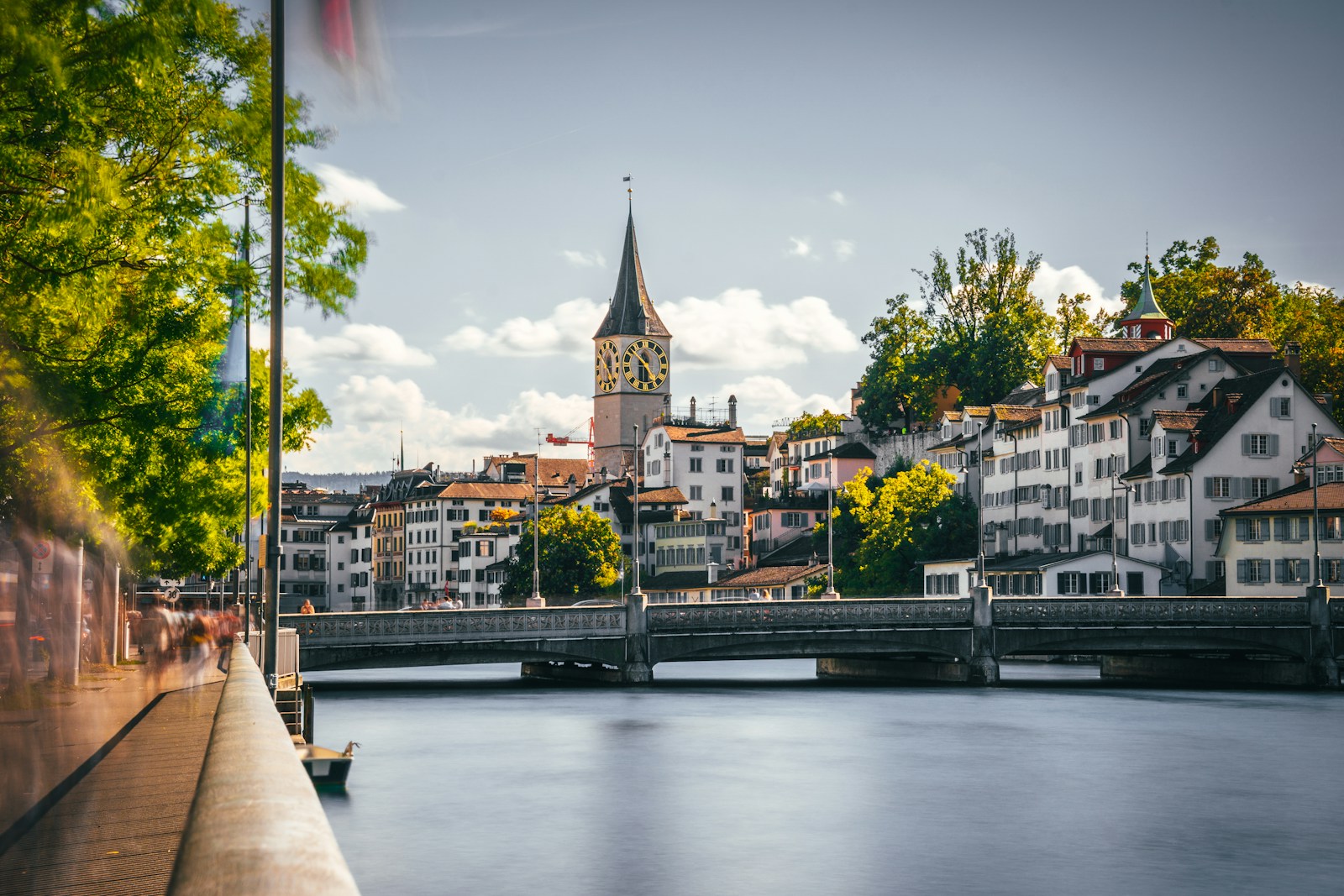
Zurich speaks German, Geneva speaks French, Lugano speaks Italian, and Graubünden runs on three languages. German is the primary language for more than 60% of the population, though Swiss German dialects are the form people speak out loud (About Switzerland, 2024).
Zurich sits inside the German-speaking region, one of four language regions the Federal Statistical Office maps across the country (2022). French is the main language of Romandie, the French-speaking west, and Geneva is part of it. Italian is the main language in Ticino and some parts of Graubünden, which puts Lugano in Italian territory (About Switzerland, 2024).
Romansh is the rarest. It’s spoken in some parts of Graubünden, a Rhaeto-Romanic language with Latin origins (About Switzerland, 2024).
The borders aren’t tidy. The Federal Statistical Office draws language regions municipality by municipality, wherever most residents speak German, French, Italian or Romansh. So the language can change between one village and the next. Read the signs when you arrive and let them tell you which phrasebook to open.
Is Swiss German the same as the German you learned?
No. Swiss German is a collection of Alemannic dialects, and in German-speaking Switzerland it’s what people say out loud, while Standard German is what they write. Those dialects are spoken by the vast majority of the population in the German-speaking regions, across all settings and social classes (About Switzerland, 2024).
Apart from text messages, Swiss German isn’t a written language. Standard German handles written correspondence, and young children only begin to learn it when they start school (About Switzerland, 2024). That’s why the menu, the ticket machine and the timetable look like the German you studied, while the conversation at the counter doesn’t sound like it.
Broadcasting follows the same split. All of SRF’s information programmes, from the news to the “Tagesschau”, are in High German, while most self-produced entertainment is made in one of the many dialects (SRG Deutschschweiz).
So don’t panic if a Zurich shopkeeper sounds nothing like your classroom tape. Read in Standard German, listen for dialect, and keep a translator within reach.
Which Swiss cantons use more than one official language?
Four cantons use more than one language: Bern, Fribourg and Valais use French and German, and Graubünden uses German, Romansh and Italian. Of Switzerland’s 26 cantons, four are officially multilingual, and Biel/Bienne in the canton of Bern speaks both German and French (About Switzerland, 2024).
Put another way, three cantons are bilingual and one is trilingual, according to the Federal Plurilingualism Delegate (2026). Graubünden is the trilingual one, and it’s unique in that three languages are spoken there.
Fribourg’s cantonal constitution names French and German as its official languages (Andreas Glaser). In Valais, French and German are the national languages.
Plan around these cantons if your route crosses them. A trip from Bern into Fribourg or Valais keeps two languages in play, and a trip into Graubünden can put three in front of you in a day. Download German and French packs for the first group, and add Italian before you head for the mountains.
How far does English get you in Switzerland?
English gets you a long way, but it sits behind the four national languages and gives out in places you’d want it. 44% of the population use English regularly, the most widespread non-national language in daily life (Language, Religion and Culture Survey, 2024).
Daily use is different from home use. 7% of residents usually speak English at home (Federal Statistical Office, 2024). In the labour market, 24% of the employed population use it (Federal Statistical Office, 2026). And 52% of people aged 15 to 64 rate their active English as good to very good when it isn’t their main language (Language, Religion and Culture Survey, 2024).
The cities lean furthest toward it. Zurich has 10.8% of its population primarily speaking English, and Geneva has 11.8% (NZZ, 2022 structural survey).
Stations are the easy case. Announcements are typically made in the language of the region, then the second national language (French or German), then English, and Italian only on trains to, from or within Ticino (The Local, 2026). In the Löwenstrasse part of Zürich HB, all announcements about long-distance trains and platform changes have also been made in English since December 2024 (SchweizHeute, 2026).
Off the beaten path is where you lean on the local language and your phone. That’s the point of going.
Which phone tools translate German, French and Italian in Switzerland?
Three apps handle the job, and each covers camera and voice. Apple’s Translate app supports French (France), German (Germany) and Italian (Italy) for text, camera and voice (App Store).
Google Translate lets you point your camera and instantly translate what you see, and its Transcribe mode helps you understand what’s being said. Microsoft Translator translates text in photos with its built-in camera viewer, and you can speak two languages into one microphone for one-on-one conversations (App Features, Microsoft Translator).
The menu in Zurich, the timetable in Lausanne and the signpost near Lugano are all camera jobs. The chat with a hotel owner is a voice job.
Offline packs help when you’re out of range. Google Translate Help gives these steps for Android:
- Next to the language, tap Download.
- If it asks you to download the language file, tap Download.
- If it’s not there, the language can’t be downloaded.
Download German, French and Italian before you leave. Then keep a live connection for everything else: maps, train info, and a translator that can handle a conversation as it happens.
Which travel eSIM should you buy for a Switzerland trip?
The table lists each company’s own published plan types, coverage and pricing model so you can compare them for a Switzerland trip. Maya sells one Global eSIM with unlimited data across 165+ countries, priced flat by trip length.
| Travel eSIM | How plans are sold | Unlimited plan allowance, as published |
|---|---|---|
| Maya Mobile | One Global eSIM for 165+ countries, unlimited data at a flat price by trip length: USD 9.99 for 3 days, USD 19.99 for 7 days, USD 27.99 for 14 days, USD 49.99 for 30 days | A daily high-speed data allowance (the Daily Quota) at up to 4G LTE or 5G where local networks offer it, reset every 24 hours; unlimited data at standard speed once the Daily Quota is used |
| Airalo | Per country, per region, or one global plan; priced in USD | Our unlimited data packages don’t have a fixed total data cap. However, to keep the network running fairly for everyone, when you use more than 3GB in a day, we’ll slow down (or “throttle”) your internet speed to 1 Mbps for the rest of that day. |
| Holafly | Per country, per region (Europe, Latin America, Cruise plans), and unlimited monthly/annual global plans | Unlimited data means there is no fixed limit on the amount of data you can use. However, some network operators may temporarily reduce your speed after a certain amount of high-speed data usage, as explained above. |
| Saily | Per country and per region, plus one global plan; by the gigabyte, unlimited, or both | The Unlimited plan gives you 5 GB per day at full 4G/5G speed, then keeps you online at 1 Mbps for the rest of the day — fast enough for navigation, messaging, and standard browsing. |
| Ubigi | Europe and World unlimited plans; monthly, annual, one-off, lifetime; unlimited, 60GB then 2 Mbps | Your unlimited data plan includes 60GB of full speed data, then optimized to 2 Mbps — this Fair Use Policy ensures a stable and fair connection for all users on the network. |
In the table, the Airalo, Holafly, Saily and Ubigi cells carry each company’s own wording or a short summary of it, and the Maya Mobile cells carry Maya’s own wording.
You choose between menus before you’ve even landed. Maya sells one plan, priced by trip length.
Installs go wrong at other companies too. A one-star Trustpilot review of aloSIM from August 13, 2026, by Osman D., reads: “No Russian manuals available. I purchased aloSIM for my family while they were traveling, but none of them could set up the eSIM. As an experienced Windows and Android user, I could have probably figured it out by trial and error, but my family couldn’t. It’s way too complicated with English-only instructions. Plus, after my payment successfully processed, the app still asked me to buy the plan again. # update since you are planning to add Russian instructions, I’ll give aloSIM another try. My family is heading to Turkey at the end of August, and if everything goes well, I’ll update my review to 5 stars.”
Why Maya Mobile keeps one eSIM on your phone from Zurich to Lugano
Install Maya once and the eSIM stays on your phone. Each trip needs a plan, and that’s the only thing you buy next time.
Pick 3, 7, 14 or 30 days and go. The Global plan gives you unlimited data across 165+ countries with a daily high-speed allowance, at one flat price for the trip length you choose, from USD 9.99. The 30-day plan is USD 49.99. Need more days? Add another plan from the app.
Each plan is bought once and stops when its chosen days are up. Auto Top-Up is opt-in and off by default, so nothing renews unless you turn it on.
FAQ
Which languages does the Swiss federal government use?
The Confederation’s official languages are German, French and Italian. Romansh is an official language in dealings with persons who speak it (Fedlex, 2026). Dispatches, reports, draft legislation and requests must normally be submitted to the Federal Assembly and its committees in German, French and Italian.
Which languages besides the national four do people speak at home in Switzerland?
English and Portuguese are the two non-national languages most often mentioned. 7% of the population usually speak English at home, and 4% speak Portuguese (Federal Statistical Office, 2026).
Which words are worth learning before a trip to Switzerland?
Learn three pairs: hello and thank you in each language. Hello is Grüezi in German-speaking Switzerland, Bonjour in the French-speaking west and Buongiorno in Ticino and the southern valleys of Graubünden (taglinetoday.com, 2025). Thank you is Danke, Merci or Grazie. For goodbye, it’s Auf Wiedersehen, Au revoir or Arrivederci (Tourismus.de).
What language are signs and train announcements in across Switzerland?
They follow the region. The general display boards at stations are in German, French or Italian, depending on the language region (SBB). Announcements at stations and on trains are typically made in the language of the region, then the second national language (French or German), then English (The Local, 2026).
Do you need a different phone plan for each language region in Switzerland?
No. Switzerland and 165+ other countries are covered by the same Maya eSIM at the same price, with no additional purchase (Maya Mobile). Service in a specific country isn’t guaranteed and may vary for reasons outside our control, and no speed is guaranteed. One eSIM stays on your phone from the German-speaking north to the Italian-speaking south.
Maya puts one Global eSIM with unlimited data across 165+ countries on your phone, so your translator, maps and train info keep working from Zurich to Lugano.